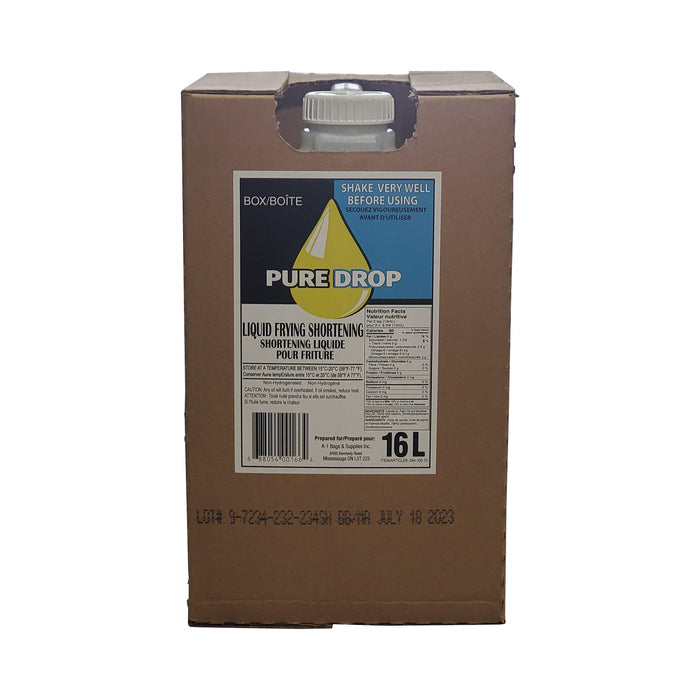
Pure Drop Liquid Frying Shortening 16 Lt
Product Overview
Pure Drop Liquid Frying Shortening is a commercially formulated liquid shortening designed for high-volume frying applications in professional foodservice environments. Supplied in 16-litre containers, this shortening frying oil is intended for use in deep fryers, commercial fry stations, and continuous frying operations where a stable, pourable frying medium is required.
Liquid shortening in this format differs from solid block shortening in that it remains in a pourable state at room temperature, simplifying handling, dispensing, and oil management in busy kitchen environments. It is a widely used frying oil category across restaurants, catering operations, institutional kitchens, and food manufacturing facilities.
What Is Liquid Frying Shortening?
Liquid shortening is a refined frying oil or oil blend formulated specifically for deep-frying and high-heat cooking applications. Unlike all-purpose cooking oils, shortening oil for frying is typically processed to offer a higher smoke point and a degree of stability under sustained heat exposure, making it a common choice for commercial fry stations operating through extended service periods.
The liquid format distinguishes this product from traditional solid or plastic shortening formats, which require melting before use. In liquid form, the product is ready to pour directly into fryers, reducing preparation steps during high-demand service times.
Common Commercial Applications
Pure Drop Liquid Frying Shortening is used across a broad range of foodservice and food production environments, including:
-
Quick service and full-service restaurants operating high-volume deep fryers for items such as french fries, chicken, fish, and appetisers
-
Catering operations requiring portable or event-scale frying capacity
-
Hotels and hospitality kitchens managing multi-station cooking lines with continuous frying output
-
Cafés and casual dining establishments incorporating fried menu items into service
-
Food trucks and carts where efficient oil handling and space management are operational priorities
-
Institutional kitchens in schools, healthcare facilities, and corporate food programs producing fried foods at scale
-
Specialty food manufacturers using liquid shortening in batch frying or food production lines
-
Grocery retailers with in-store deli or hot food programs operating commercial fryers
Product Characteristics
| Feature |
Detail |
| Product Name |
Pure Drop Liquid Frying Shortening |
| Format |
Liquid (pourable at room temperature) |
| Container Size |
16 litres |
| Application |
Deep frying, high-heat commercial cooking |
| Use Type |
Foodservice and commercial kitchen |
| Consistency |
Liquid shortening |
The 16-litre container format is suited to operations with regular frying output, providing sufficient volume to minimise frequent oil changes while remaining manageable for kitchen staff to handle and store. The container size is a common format in commercial foodservice supply chains.
Functional Characteristics of Liquid Shortening for Frying
Commercial liquid shortening is selected for frying applications based on several functional properties that are relevant to professional kitchen operators:
-
Pourable consistency — No melting or pre-conditioning required before loading into fryers
-
High-heat application — Formulated for deep-frying temperatures typical of commercial fry station operation
-
Oil stability — Shortening frying oils are generally formulated to withstand the sustained heat exposure involved in continuous-use commercial frying
-
Neutral flavour profile — Liquid shortening typically imparts a neutral taste, allowing the natural flavour of fried food products to remain the focus
-
Consistent viscosity — Liquid format supports easier portioning, dispensing, and oil level management in commercial fryer basins
-
Reduced handling steps — Eliminates the solid-shortening melting step, which can be relevant during high-volume service ramp-up
Oil Management Considerations in Commercial Frying Operations
In commercial frying environments, oil management practices directly affect both product quality and operational costs. Liquid shortening for frying is subject to the same general oil degradation factors as other frying media, including heat, moisture from food products, and food particle accumulation.
Standard commercial kitchen practices for frying oil management include:
-
Regular filtering — Removing food particles through commercial fryer filtration systems to extend usable oil life
-
Monitoring oil colour and odour — Visual and sensory checks are a common method for assessing oil condition during service
-
Maintaining appropriate fry temperatures — Operating fryers within the recommended temperature range helps manage the rate of oil breakdown
-
Proper fryer load management — Avoiding overloading fryers with high-moisture foods reduces the rate of oil degradation
-
Scheduled oil changes — Establishing regular oil change cycles based on volume and product type is standard practice in professional kitchens
Operators should follow equipment manufacturer guidelines and their own kitchen protocols when determining oil change frequency and handling procedures.
Packaging and Storage
The 16-litre container format is a standard commercial packaging size for liquid frying shortening in the foodservice supply sector. Containers of this type are generally stored upright in a cool, dry area away from direct heat sources and direct sunlight, in line with edible oil storage best practices.
Operators should confirm specific storage temperature ranges and shelf life details from the product label or supplier documentation at time of order.
Bulk and Wholesale Buyer Considerations
For foodservice operations purchasing liquid frying shortening in volume, the 16-litre format allows for manageable inventory rotation aligned with frying frequency and service volume. Buyers operating multiple fryer stations or high-output service lines may benefit from forecasting weekly oil consumption to establish consistent ordering cycles and maintain sufficient on-hand stock.
Proper storage conditions, including ambient temperature and away from heat or moisture, are relevant to maintaining product quality between delivery and use. As with all edible oils, first-in, first-out rotation is a standard inventory practice.
This product is available for wholesale and bulk delivery across the Greater Toronto Area (GTA).
Frequently Asked Questions (FAQs)
Q: What is liquid frying shortening, and how does it differ from regular cooking oil? Liquid frying shortening is a commercially refined oil or oil blend specifically formulated for deep-frying applications. It is processed to perform under the sustained high-heat conditions of commercial fryer operation. While regular cooking oil is a broader category used across various cooking methods, liquid shortening for frying is a product category targeted specifically at fry station use.
Q: How does liquid shortening differ from solid shortening?
Solid shortening is a semi-solid or plastic fat that requires melting before it can be loaded into a fryer. Liquid shortening is already in a pourable state at room temperature, eliminating the pre-melting step. In high-volume or time-sensitive kitchen environments, the liquid format can reduce preparation time during service ramp-up.
Q: What types of foods are typically fried in liquid shortening?
Liquid frying shortening is commonly used for a wide range of deep-fried foods, including french fries, chicken pieces, fish fillets, onion rings, doughnuts, spring rolls, and other battered or breaded items commonly found on commercial foodservice menus.
Q: How often should liquid frying shortening be changed in a commercial fryer?
Oil change frequency depends on several operational factors, including frying volume, the types of food being fried, fryer temperature management, and filtration practices. There is no universal schedule — operators typically assess oil condition through visual inspection, odour, and colour changes, and establish change cycles based on their specific output and kitchen protocols.
Q: Can liquid shortening be filtered and reused?
Yes. Commercial frying operations commonly filter liquid shortening using dedicated fryer filtration equipment to remove food particles and extend usable oil life. Regular filtering is a standard oil management practice in professional kitchens. However, all frying oils have a finite usable life and will require replacement over time regardless of filtration practices.
Q: How should a 16-litre container of liquid shortening be stored?
Liquid frying shortening should generally be stored in a cool, dry area, away from direct heat, sunlight, and moisture. Containers should be kept sealed when not in use. Specific storage conditions and shelf life should be confirmed on the product label or with the supplier at time of delivery.
Q: Is liquid frying shortening suitable for use in all types of commercial fryers?
Liquid shortening is compatible with most standard commercial deep fryer equipment. Operators should confirm the suitability of any frying medium with their specific fryer model and manufacturer guidelines, particularly for high-efficiency or specialised fryer systems.
Q: What is the typical shelf life of liquid frying shortening before opening?
Shelf life for liquid edible oils and shortenings varies depending on the specific product formulation and storage conditions. Buyers should confirm shelf life details directly from the product label or supplier documentation at time of order to support proper inventory planning and rotation